
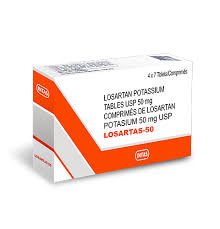
PRESCRIPTION NOTICE: Losartas 50 mg is a Prescription Only Medicine (POM). It cannot legally be dispensed without a valid prescription from a licensed healthcare provider in Kenya. Do not use this medicine without medical supervision. Do not share this medicine with others even if they appear to have the same condition.
Losartas Tablets 50 mg are a prescription-only angiotensin II receptor blocker (ARB) containing losartan potassium as the active ingredient. Each pack contains 28 film-coated tablets providing a four-week supply at standard once-daily dosing. Losartan is the first clinically approved ARB and remains one of the most widely prescribed, extensively studied, and well-established ARBs in global and Kenyan medical practice, with a robust evidence base spanning hypertension management, diabetic nephropathy, stroke prevention, and heart failure.
Losartan potassium works by selectively blocking the angiotensin II type 1 (AT1) receptor — the primary receptor through which angiotensin II exerts its vasoconstrictive and sodium-retaining effects — effectively lowering blood pressure, protecting the kidneys from hypertensive and diabetic damage, and reducing the risk of cardiovascular events in high-risk patient populations. Losartan is included on the Kenya Essential Medicines List (KEML) and is one of the most commonly prescribed ARBs in Kenya due to its established efficacy, broad indications, and relative affordability compared to newer ARBs. If you have been prescribed Losartas 50 mg for hypertension treatment in Kenya or any other indication, this medicine must be taken strictly as directed by your healthcare provider. The price of Losartas 50 mg in Kenya varies by pharmacy and is dispensed only on presentation of a valid prescription.
Key Benefits
- First and most extensively studied ARB — decades of robust clinical evidence across multiple cardiovascular and renal indications
- Effective once-daily blood pressure control — a single daily dose provides sustained antihypertensive effect
- Proven diabetic nephropathy protection — losartan significantly reduces the rate of progression of kidney disease and the risk of end-stage renal disease in hypertensive patients with type 2 diabetes and proteinuria
- Stroke prevention — the landmark LIFE trial demonstrated that losartan reduces the risk of stroke more effectively than atenolol in hypertensive patients with left ventricular hypertrophy
- Heart failure management — indicated for reducing cardiovascular mortality in patients with heart failure intolerant of ACE inhibitors
- Unique uricosuric effect — losartan actively promotes renal uric acid excretion, lowering serum uric acid levels — a clinically beneficial property distinguishing it from other ARBs and particularly relevant in hypertensive patients with hyperuricaemia or gout
- No ACE inhibitor-associated dry cough — losartan does not inhibit bradykinin degradation, providing excellent tolerability in patients intolerant of ACE inhibitors such as enalapril
- Included on the Kenya Essential Medicines List (KEML) — recognised as an essential medicine for the Kenyan healthcare system
- Well-established safety profile with decades of global and Kenyan clinical use
- Once-daily dosing — supports long-term treatment adherence
What It Is & How It Works
Active Ingredient
Each film-coated tablet contains:
| Active Ingredient | Strength | Role |
|---|---|---|
| Losartan Potassium | 50 mg | Selective AT1 receptor antagonist (ARB) — blocks the renin-angiotensin-aldosterone system to lower blood pressure and protect target organs |
How It Works
AT1 Receptor Blockade — Primary Mechanism
The renin-angiotensin-aldosterone system (RAAS) plays a central role in the pathophysiology of hypertension, heart failure, and kidney disease. In hypertensive states, excessive RAAS activation drives sustained angiotensin II production — a potent vasoconstrictor and promoter of aldosterone secretion. Losartan selectively and competitively antagonises the AT1 receptor — the receptor subtype through which angiotensin II exerts its pathological cardiovascular effects. By blocking AT1 receptors, losartan:
- Prevents angiotensin II-mediated vasoconstriction of arterial smooth muscle — directly reducing peripheral vascular resistance and systemic blood pressure
- Inhibits angiotensin II-stimulated aldosterone secretion — reducing sodium and water retention, contributing to intravascular volume reduction and additional blood pressure lowering
- Blocks angiotensin II-driven cardiac and vascular remodelling — including left ventricular hypertrophy and vascular smooth muscle proliferation — providing long-term end-organ protection
- Reduces intraglomerular capillary pressure — by blocking angiotensin II-mediated efferent arteriolar constriction in the kidney, losartan reduces the haemodynamic stress on glomerular capillaries that drives proteinuria and progressive renal damage in hypertensive and diabetic nephropathy
- Allows AT2 receptor stimulation by the resulting elevated circulating angiotensin II — producing vasodilatory, antiproliferative, and natriuretic effects that complement the AT1 blockade benefit
Active Metabolite — EXP3174
Following oral administration, losartan undergoes significant first-pass hepatic metabolism, with approximately 14% of an oral dose being converted by CYP2C9 and CYP3A4 to its pharmacologically active carboxylic acid metabolite — EXP3174. EXP3174 is 10–40 times more potent than losartan at the AT1 receptor, has a longer half-life (6–9 hours compared to losartan’s 2 hours), and is responsible for the majority of losartan’s antihypertensive activity. The combined activity of losartan and EXP3174 provides sustained AT1 receptor blockade over the full 24-hour dosing interval.
Unique Uricosuric Effect
Losartan possesses a unique pharmacological property not shared by other ARBs — it actively inhibits uric acid reabsorption in the proximal tubule of the kidney by blocking the urate anion exchanger URAT1, promoting urinary uric acid excretion and lowering serum uric acid levels. This uricosuric effect is clinically meaningful and provides an important additional benefit in hypertensive patients with hyperuricaemia or gout — conditions that are increasingly recognised as cardiovascular risk factors and that carry growing prevalence in Kenya’s urbanising population.
Unlike ACE Inhibitors
Losartan blocks the RAAS at the AT1 receptor level rather than at the ACE enzyme level, producing equivalent RAAS blockade without inhibiting the breakdown of bradykinin. Bradykinin accumulation is responsible for the persistent dry cough that affects a significant proportion of patients on ACE inhibitors — a side effect that carries a substantially higher incidence in Black African patients and is one of the most common reasons for antihypertensive non-adherence in Kenya. Losartan’s mechanism entirely avoids this problem.
Classification
Losartas 50 mg is classified as a Prescription Only Medicine (POM) in Kenya. It must only be initiated, monitored, and adjusted by a licensed healthcare provider. A valid prescription is required for dispensing at any registered pharmacy in Kenya.
Formulation
Film-coated tablets. Each pack contains 28 tablets. Tablets should be swallowed whole with water, with or without food, at the same time each day.
Uses & Indications
Losartas 50 mg Tablets are indicated for the management of:
Hypertension
- Essential hypertension (primary high blood pressure) — as monotherapy or in combination with other antihypertensive agents in adults and children aged 6 years and above where weight-based dosing is appropriate
Diabetic Nephropathy
- Hypertension with type 2 diabetes mellitus and proteinuria — losartan is specifically indicated to reduce the rate of progression of renal disease (as measured by the occurrence of doubling of serum creatinine or end-stage renal disease) in patients with hypertension, type 2 diabetes, and proteinuria; the RENAAL trial provided the definitive evidence base for this indication
Cardiovascular Risk Reduction
- Reduction of cardiovascular risk in hypertensive patients with left ventricular hypertrophy — losartan is indicated to reduce the risk of stroke in hypertensive adult patients with electrocardiographic evidence of left ventricular hypertrophy (LVH); based on the landmark LIFE clinical trial
Heart Failure
- Chronic heart failure — in patients who are intolerant of ACE inhibitors; losartan reduces the risk of cardiovascular death and hospitalisation for heart failure in patients who cannot tolerate ACE inhibitor therapy
IMPORTANT: The decision to initiate, adjust, or discontinue Losartas therapy must be made exclusively by a licensed healthcare provider based on individual clinical assessment, blood pressure targets, renal function, and electrolyte monitoring. Do not self-prescribe or alter your dose without medical advice.
Dosage & Administration
This medicine requires a valid prescription. Use only as prescribed by your healthcare provider. The following dosage information is provided for general reference only and does not constitute prescribing advice.
| Indication | Starting Dose | Usual Maintenance Dose | Maximum Daily Dose |
|---|---|---|---|
| Hypertension | As directed by physician | As directed by physician | As directed by physician |
| Hypertension with volume depletion or hepatic impairment | As directed by physician | As directed by physician | As directed by physician |
| Diabetic nephropathy | As directed by physician | As directed by physician | As directed by physician |
| Stroke prevention (LVH) | As directed by physician | As directed by physician | As directed by physician |
| Heart failure | As directed by physician | As directed by physician | As directed by physician |
| Children 6–17 years (hypertension) | As directed by physician | As directed by physician | As directed by physician |
| Renal impairment | As directed by physician | As directed by physician | As directed by physician |
| Hepatic impairment | As directed by physician | As directed by physician | As directed by physician |
| Elderly patients (65+ years) | As directed by physician | As directed by physician | As directed by physician |
Administration Instructions
- Take this medicine exactly as prescribed — do not increase, decrease, or skip doses without medical advice
- Take once daily at the same time each day — consistent timing maintains stable drug levels and sustained blood pressure control
- May be taken with or without food — food does not significantly affect the overall bioavailability of losartan
- Swallow tablets whole with a full glass of water — do not crush, chew, or split
- Do not stop taking this medicine suddenly without consulting your doctor — abrupt discontinuation may result in rebound blood pressure elevation
- If a dose is missed, take it as soon as you remember on the same day — if the next day has begun, skip the missed dose and continue as normal; do not double dose
- Maintain adequate hydration — particularly in hot weather, during physical activity, or during illness with vomiting or diarrhoea — to reduce the risk of excessive blood pressure lowering and electrolyte disturbance
- Attend all scheduled follow-up appointments for blood pressure monitoring, renal function tests, and serum electrolyte checks — serum potassium and creatinine monitoring is essential during losartan therapy
Possible Side Effects
Like all medicines, Losartas 50 mg may cause side effects in some patients. These are generally mild and uncommon. Report any new or worsening symptoms to your healthcare provider promptly.
Common
- Dizziness or light-headedness — particularly upon standing (orthostatic hypotension); rise slowly from sitting or lying positions; most common after the first dose or following dose increases
- Hyperkalaemia (elevated serum potassium) — ARB class effect; aldosterone inhibition reduces urinary potassium excretion; particularly significant in patients with renal impairment, diabetes, or those taking potassium supplements or potassium-sparing diuretics; regular serum potassium monitoring is essential
- Headache — usually mild and transient
- Fatigue
Less Common
- Hypotension (low blood pressure) — particularly in volume-depleted patients or those on concurrent diuretics; may cause dizziness, fainting, or falls
- Elevated creatinine or blood urea nitrogen — a modest rise on initiation of ARB therapy is expected due to reduced intraglomerular pressure; significant or progressive rises warrant medical review and dose reassessment
- Anaemia — mild reduction in haemoglobin reported; more common in patients with renal impairment
- Upper respiratory tract infections — nasopharyngitis
- Back pain, leg pain, or musculoskeletal pain
- Insomnia — mild sleep disturbances reported in some patients
- Elevated liver enzymes — rare; hepatitis has been reported rarely with losartan
- Lowering of serum uric acid — a pharmacological effect of losartan’s uricosuric action; clinically beneficial in most patients but monitor in those on urate-lowering therapy
WARNING: Rare but serious — seek immediate medical attention if you experience: angioedema (sudden swelling of the face, lips, tongue, or throat — although less common with ARBs than ACE inhibitors, losartan-induced angioedema has been reported and is a potentially life-threatening emergency requiring immediate treatment), severe hypotension causing loss of consciousness (particularly in volume-depleted patients after the first dose), acute kidney injury (significant reduction in urine output or rapidly rising creatinine — particularly in patients with bilateral renal artery stenosis or severe volume depletion), severe hyperkalaemia (muscle weakness, paralysis, or cardiac arrhythmias), or signs of serious liver reactions (jaundice, severe abdominal pain, dark urine).
This is not a complete list of side effects. Report all side effects to your healthcare provider.
Warnings & Precautions
CONTRAINDICATION: Do NOT use Losartas 50 mg if you are pregnant, have severe hepatic impairment, known hypersensitivity to losartan potassium or any excipient in this formulation, or if you are taking aliskiren and have diabetes or renal impairment.
Do Not Use If You:
- Are pregnant — losartan causes serious and potentially fatal fetal harm including renal dysplasia, oligohydramnios, fetal limb contractures, neonatal renal failure, and fetal death; ARBs are absolutely contraindicated in all trimesters of pregnancy
- Are breastfeeding — it is not known whether losartan passes into human breast milk; use is not recommended during breastfeeding; consult a doctor
- Have severe hepatic impairment — losartan is extensively hepatically metabolised; plasma levels are dramatically elevated in severe liver disease
- Have known hypersensitivity to losartan or any excipient
- Are taking aliskiren and have diabetes or an eGFR below 60 mL/min — dual RAAS blockade in this setting significantly increases the risk of hypotension, hyperkalaemia, and renal failure
Use With Caution If You Have:
- Bilateral renal artery stenosis or stenosis of the artery to a single functioning kidney — ARBs can precipitate acute kidney injury in this setting; use only under specialist supervision with close monitoring
- Significant aortic or mitral valve stenosis or hypertrophic obstructive cardiomyopathy — risk of severe hypotension
- Volume or sodium depletion — correct dehydration before initiating to reduce the risk of first-dose hypotension; consider initiating at 25 mg in this setting
- Renal impairment — no initial dose adjustment is required, but monitor renal function, electrolytes, and blood pressure closely; losartan may cause further reduction in renal function in patients with pre-existing kidney disease
- Hepatic impairment — initiate at 25 mg once daily; do not exceed 50 mg in significant hepatic impairment due to impaired conversion of losartan to its active metabolite EXP3174 and elevated losartan levels
- Primary hyperaldosteronism — ARBs are generally less effective in this condition; alternative agents may be more appropriate
- Heart failure — use under specialist supervision; monitor renal function and electrolytes closely during initiation and titration
- Diabetes mellitus — both diabetes and ARBs independently predispose to hyperkalaemia; monitor potassium levels closely; losartan’s nephroprotective benefit makes it a preferred antihypertensive in diabetic patients with proteinuria
- Elderly patients — increased susceptibility to hypotension, falls, and renal impairment; monitor blood pressure and renal function carefully
- Hyperuricaemia or gout — losartan’s uricosuric effect is generally beneficial in this patient group; monitor uric acid levels and discuss with your doctor if on urate-lowering therapy
Do Not Combine With (Selected Key Interactions — Consult Pharmacist for Full Review):
- Other RAAS blockers (ACE inhibitors, aliskiren, other ARBs) — dual or triple RAAS blockade significantly increases the risk of hypotension, hyperkalaemia, and acute renal failure without additional cardiovascular benefit; avoid
- Potassium-sparing diuretics (spironolactone, amiloride, eplerenone) or potassium supplements — additive hyperkalaemia risk; monitor serum potassium closely and frequently
- Lithium — losartan reduces renal lithium excretion, increasing lithium plasma levels and toxicity risk; monitor lithium levels closely or avoid combination
- NSAIDs (ibuprofen, diclofenac, aspirin at anti-inflammatory doses) — reduce the antihypertensive efficacy of losartan and significantly increase the risk of acute kidney injury; the ARB-diuretic-NSAID combination is particularly dangerous and must be avoided
- CYP2C9 inhibitors (fluconazole, amiodarone, some sulphonamides) — inhibit the conversion of losartan to its active metabolite EXP3174, potentially reducing antihypertensive efficacy; monitor blood pressure closely
- CYP2C9 inducers (rifampicin, carbamazepine, phenytoin) — may increase the conversion of losartan to EXP3174 or alter overall drug levels; monitor blood pressure and clinical response
- Antidiabetic agents (insulin, sulphonylureas including glimepiride) — ARBs may enhance the glucose-lowering effect; monitor blood glucose closely and adjust antidiabetic therapy if necessary
- Other antihypertensive agents and diuretics — additive hypotensive effects; monitor blood pressure closely and adjust doses accordingly
- NSAIDs and COX-2 inhibitors — as above; avoid concurrent use where possible
- Alcohol — enhances the hypotensive effect; advise patients to limit alcohol intake
CLINICAL NOTE (Kenya-specific): Losartan potassium (Losartas) occupies a critically important position in Kenyan clinical practice and is included on the Kenya Essential Medicines List, reflecting its clinical versatility, established efficacy, and relative affordability. Several Kenya-specific considerations are essential in the safe and effective use of this medicine. Losartan’s diabetic nephropathy indication is of particular importance in Kenya, where type 2 diabetes prevalence is rapidly increasing and diabetic kidney disease is a leading and largely preventable cause of end-stage renal disease — a condition for which dialysis access remains severely limited across the country. Early initiation of losartan in hypertensive Kenyan patients with type 2 diabetes and any degree of proteinuria represents one of the most impactful and evidence-based interventions available in the primary prevention of dialysis-dependent renal failure. Losartan’s unique uricosuric effect distinguishes it from other ARBs and is clinically relevant in the growing number of Kenyan patients with hyperuricaemia and gout — conditions associated with the dietary changes accompanying urbanisation. The well-documented higher incidence of ACE inhibitor-induced cough in Black African patients makes losartan an excellent and well-tolerated alternative ARB for Kenyan patients intolerant of enalapril or other ACE inhibitors. NSAIDs — particularly ibuprofen and diclofenac — are very widely and frequently unsupervised used in Kenya; pharmacists must explicitly counsel all patients on losartan about the need to avoid concurrent NSAID use given the significant risk of acute kidney injury and reduced antihypertensive efficacy. Finally, the absolute contraindication in pregnancy must be emphasised clearly to all women of childbearing potential given the severe and potentially fatal fetal consequences of ARB exposure during pregnancy.
Keep out of reach of children. Store all medicines safely and securely.
Storage Instructions
- Store below 30°C in a cool, dry place
- Protect from direct sunlight, moisture, and excessive heat
- Keep tablets in their original blister packaging
- Store out of reach and sight of children
- Do not use after the expiry date printed on the packaging
- Do not transfer tablets to another container
- Dispose of unused or expired tablets safely at your local registered pharmacy — do not flush down the toilet or discard in household waste
Mandatory Disclaimer
This medicine requires a valid prescription. Do not use without medical advice. Losartas 50 mg (Losartan Potassium) is a Prescription Only Medicine (POM) that must be initiated, monitored, and adjusted exclusively by a licensed healthcare provider. Do not self-prescribe, purchase without a valid prescription, share this medicine with others, or stop treatment without consulting your doctor. Losartan is absolutely contraindicated in pregnancy — women of childbearing potential must use effective contraception during treatment and must inform their doctor immediately if they become or plan to become pregnant. Regular medical follow-up including blood pressure monitoring, renal function tests, and serum electrolyte checks is a non-negotiable and essential component of safe Losartas therapy. This product information is provided for general educational reference only and does not constitute medical advice or replace the guidance of a qualified healthcare professional.
References
- Kenya Essential Medicines List (KEML) & Kenya Clinical Guidelines — Cardiovascular and Renal Disease: Losartan Potassium Indications and Prescribing Guidance
- Brenner BM et al. — RENAAL Trial: Losartan and the Risk of End-Stage Renal Disease in Patients with Type 2 Diabetes. New England Journal of Medicine, 2001

Reviews
There are no reviews yet.