
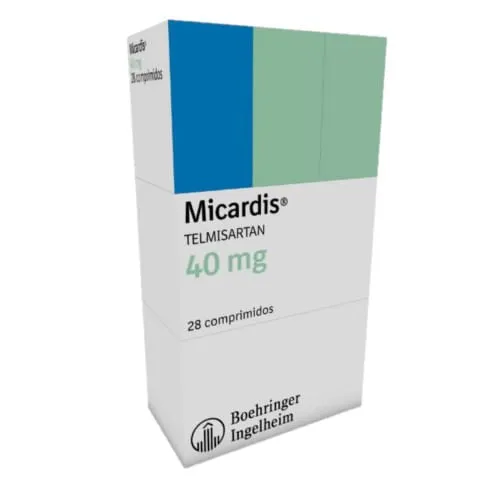
PRESCRIPTION NOTICE: Micardis 40 mg is a Prescription Only Medicine (POM). It cannot legally be dispensed without a valid prescription from a licensed healthcare provider in Kenya. Do not use this medicine without medical supervision. Do not share this medicine with others even if they appear to have the same condition.
Micardis 40 mg Tablets are a prescription-only angiotensin II receptor blocker (ARB) containing telmisartan as the active ingredient, manufactured by Boehringer Ingelheim. Each pack contains 28 film-coated tablets providing a four-week supply at standard once-daily dosing. The 40 mg strength represents the standard starting and maintenance dose of telmisartan for the management of essential hypertension, making it the most commonly initiated Micardis formulation in clinical practice.
Micardis 40 mg shares the same pharmacological profile and clinical advantages as Micardis 80 mg — including telmisartan’s unrivalled 24-hour blood pressure coverage, superior trough-to-peak ratio, unique PPARγ partial agonist activity, and excellent tolerability — at a starting dose that allows careful titration in patients who are newly initiated on telmisartan, elderly patients, and those with hepatic impairment or cardiovascular sensitivity. Where Micardis 80 mg is indicated for patients requiring maximum ARB-class antihypertensive effect, Micardis 40 mg is the appropriate starting point and maintenance dose for the majority of hypertensive patients initiating telmisartan therapy. If you have been prescribed Micardis 40 mg for hypertension treatment in Kenya, this medicine must be taken strictly as directed by your healthcare provider. The price of Micardis 40 mg in Kenya varies by pharmacy and is dispensed only on presentation of a valid prescription.
Key Benefits
- Longest duration of action among all ARBs — telmisartan’s half-life of approximately 24 hours provides the most complete and consistent 24-hour blood pressure coverage of any ARB
- Superior trough-to-peak ratio — maintains blood pressure control throughout the full 24-hour dosing interval, including the critical early morning blood pressure surge when cardiovascular events are most common
- Ideal starting dose — 40 mg is the recommended initiation dose for most patients, allowing careful titration to 80 mg if additional blood pressure lowering is required
- Unique PPARγ partial agonist activity — delivers additional insulin-sensitising and metabolic benefits beyond blood pressure lowering, particularly relevant in hypertensive patients with metabolic syndrome, pre-diabetes, or type 2 diabetes
- Appropriate for patients with hepatic impairment — the maximum recommended dose in hepatic impairment is 40 mg, making this formulation the correct choice in this important patient subgroup
- No ACE inhibitor-associated dry cough — telmisartan provides equivalent RAAS blockade without bradykinin accumulation, making it ideal for patients intolerant of ACE inhibitors such as enalapril
- Renal and cardiovascular organ protection — ARB-class RAAS blockade reduces proteinuria, slows the progression of diabetic and hypertensive nephropathy, and provides cardiovascular organ protection
- Hepatically eliminated — no dose adjustment required in mild to moderate renal impairment, a clinically valuable characteristic in patients with concurrent kidney disease
- Once-daily dosing — supports long-term treatment adherence and consistent blood pressure control
- Well-established safety profile supported by landmark global clinical trials including ONTARGET and TRANSCEND
What It Is & How It Works
Active Ingredient
Each film-coated tablet contains:
| Active Ingredient | Strength | Role |
|---|---|---|
| Telmisartan | 40 mg | Long-acting selective AT1 receptor antagonist (ARB) with additional PPARγ partial agonist activity |
How It Works
Angiotensin II AT1 Receptor Blockade — Primary Mechanism
The renin-angiotensin-aldosterone system (RAAS) is the principal hormonal regulator of blood pressure and fluid homeostasis. In hypertensive patients, excessive RAAS activation drives sustained vasoconstriction, sodium and water retention, and progressive cardiac and vascular remodelling — all of which contribute to elevated blood pressure and end-organ damage.
Telmisartan is a highly selective, non-competitive antagonist of the angiotensin II type 1 (AT1) receptor — the receptor through which virtually all of angiotensin II’s pathological cardiovascular effects are mediated. By binding with exceptionally high affinity and slow dissociation kinetics to AT1 receptors, telmisartan:
- Blocks angiotensin II-mediated vasoconstriction of arterial smooth muscle — reducing peripheral vascular resistance and systemic blood pressure
- Inhibits angiotensin II-stimulated aldosterone secretion from the adrenal cortex — reducing sodium and water retention and intravascular volume
- Prevents angiotensin II-driven cardiac hypertrophy and vascular smooth muscle proliferation — protecting against hypertensive end-organ damage
- Reduces intraglomerular pressure in the kidneys — providing nephroprotective benefits particularly valuable in hypertensive patients with diabetes or proteinuria
- Allows AT2 receptor stimulation by elevated circulating angiotensin II — producing complementary vasodilatory and antiproliferative effects
Why Telmisartan Provides Superior 24-Hour Blood Pressure Coverage
Telmisartan’s uniquely long half-life of approximately 20–24 hours — the longest of any available ARB — results from its exceptionally high lipophilicity, large volume of distribution, and non-competitive binding at the AT1 receptor. Unlike competitive ARBs, telmisartan cannot be displaced from its receptor by rising endogenous angiotensin II levels during the late dosing interval, ensuring sustained and clinically meaningful AT1 receptor blockade throughout the full 24 hours between doses. This translates into superior control of the early morning blood pressure surge — the period of highest cardiovascular event risk — without the end-of-dose blood pressure escape seen with shorter-acting ARBs.
PPARγ Partial Agonist Activity — Secondary Mechanism
Telmisartan is unique among ARBs in acting as a partial agonist at peroxisome proliferator-activated receptor gamma (PPARγ) — a nuclear receptor regulating genes governing glucose and lipid metabolism. This activity produces:
- Improved insulin sensitivity — reducing peripheral insulin resistance
- Favourable effects on lipid metabolism — modest reductions in triglycerides and free fatty acids
- Anti-inflammatory effects in adipose tissue — reducing adipokine-driven metabolic inflammation
- Potential attenuation of the metabolic adverse effects of thiazide diuretics when used in combination
This PPARγ activity is clinically relevant in the significant proportion of hypertensive Kenyan patients who have concurrent metabolic syndrome, pre-diabetes, or type 2 diabetes.
Classification
Micardis 40 mg is classified as a Prescription Only Medicine (POM) in Kenya. It must only be initiated, monitored, and adjusted by a licensed healthcare provider. A valid prescription is required for dispensing at any registered pharmacy in Kenya.
Formulation
Film-coated tablets. Each pack contains 28 tablets. Tablets should be swallowed whole with water, with or without food, at the same time each day. Telmisartan tablets are moisture-sensitive — keep in original packaging until immediately before use.
Uses & Indications
Micardis 40 mg Tablets are indicated for:
- Essential hypertension (primary high blood pressure) — as the standard initiating dose in adults, or as an ongoing maintenance dose where 40 mg provides adequate blood pressure control
- Hypertension in patients with hepatic impairment — 40 mg is the maximum recommended daily dose in patients with hepatic impairment due to telmisartan’s predominantly biliary elimination
- Hypertension in elderly patients — 40 mg is the appropriate starting dose in elderly patients who may be more sensitive to blood pressure lowering; titration to 80 mg is based on individual clinical response
- Hypertension with concurrent diabetes or metabolic syndrome — telmisartan’s PPARγ activity provides additional metabolic benefits in this important patient subgroup
- As an ACE inhibitor substitute — in patients who develop ACE inhibitor-induced persistent dry cough or angioedema (such as with enalapril or ramipril)
- Step-down therapy — in patients previously stabilised on Micardis 80 mg whose blood pressure targets are being maintained and a dose reduction is clinically appropriate
- Initiation of combination therapy — as the telmisartan component before up-titration to 80 mg or combination with amlodipine (as in Twynsta) or hydrochlorothiazide when dual therapy is subsequently required
IMPORTANT: The decision to initiate, adjust, or discontinue Micardis 40 mg therapy must be made exclusively by a licensed healthcare provider. If adequate blood pressure control is not achieved on Micardis 40 mg after 4–8 weeks, the dose may be increased to 80 mg once daily or combination therapy may be considered — always under medical guidance. Do not self-adjust your dose without consulting your doctor.
Dosage & Administration
This medicine requires a valid prescription. Use only as prescribed by your healthcare provider. The following dosage information is provided for general reference only and does not constitute prescribing advice.
| Patient Group | Dose | Frequency | Notes |
|---|---|---|---|
| Adults — initial therapy | As directed | As directed | As directed |
| Adults — if additional BP lowering needed | As directed | As directed | As directed |
| Elderly patients (65+ years) | As directed | As directed | As directed |
| Mild to moderate renal impairment | As directed | As directed | As directed |
| Severe renal impairment | As directed | As directed | As directed |
| Mild to moderate hepatic impairment | As directed | As directed | As directed |
| Severe hepatic impairment | As directed | As directed | As directed |
| Paediatric patients (under 18 years) | As directed | As directed | As directed |
Administration Instructions
- Take this medicine exactly as prescribed — do not increase, decrease, or skip doses without medical advice
- Take once daily at the same time each day — consistent timing maximises 24-hour blood pressure coverage
- May be taken with or without food — food does not significantly affect the absorption of telmisartan
- Swallow tablets whole with a full glass of water — do not crush, chew, or split
- Remove tablets from the blister immediately before use — telmisartan is moisture-sensitive and degrades if left exposed to air or humidity
- Do not stop taking this medicine suddenly without consulting your doctor — abrupt discontinuation may result in rebound blood pressure elevation
- If a dose is missed, take it as soon as you remember on the same day — if the next day has begun, skip the missed dose and continue as normal; do not double dose
- Maintain adequate hydration — particularly in hot weather, during physical activity, or during illness with vomiting or diarrhoea — to reduce the risk of excessive blood pressure lowering
- Attend all scheduled follow-up appointments for blood pressure monitoring, renal function, and serum electrolyte checks — particularly potassium monitoring
Possible Side Effects
Like all medicines, Micardis 40 mg may cause side effects in some patients. These are generally mild and uncommon. Report any new or worsening symptoms to your healthcare provider promptly.
Common
- Dizziness or light-headedness — particularly upon standing (orthostatic hypotension); rise slowly from sitting or lying positions; most common after the first dose or following dose increases
- Headache — usually mild and transient
- Fatigue or weakness
- Hyperkalaemia (elevated serum potassium) — ARBs reduce aldosterone-mediated potassium excretion; particularly significant in patients with renal impairment, diabetes, or those taking potassium supplements or potassium-sparing diuretics; regular potassium monitoring is essential
- Upper respiratory tract infections — sinusitis, nasopharyngitis
Less Common
- Hypotension (low blood pressure) — particularly in volume-depleted patients or those on concurrent diuretics; may cause dizziness, fainting, or falls
- Back pain or musculoskeletal pain
- Elevated creatinine or blood urea nitrogen — a modest rise in serum creatinine on initiation is expected due to reduced intraglomerular pressure; significant or progressive rises warrant medical review
- Diarrhoea or abdominal discomfort
- Anaemia — mild reduction in haemoglobin reported in clinical trials
- Elevated liver enzymes — rare; monitor in patients with pre-existing hepatic conditions
WARNING: Rare but serious — seek immediate medical attention if you experience: angioedema (sudden swelling of the face, lips, tongue, or throat — although less common with ARBs than ACE inhibitors, telmisartan-induced angioedema has been reported and is a potentially life-threatening emergency), severe hypotension causing loss of consciousness (particularly after first dose in volume-depleted patients), acute kidney injury (significant reduction in urine output or rapidly rising creatinine — particularly in patients with bilateral renal artery stenosis), severe hyperkalaemia (muscle weakness, paralysis, or cardiac arrhythmias), or severe hepatic reactions (jaundice, severe abdominal pain, dark urine).
This is not a complete list of side effects. Report all side effects to your healthcare provider.
Warnings & Precautions
CONTRAINDICATION: Do NOT use Micardis 40 mg if you are pregnant, have severe hepatic impairment, biliary obstructive disorders, or known hypersensitivity to telmisartan or any excipient in this formulation. Do NOT use in combination with aliskiren in patients with diabetes or renal impairment.
Do Not Use If You:
- Are pregnant — telmisartan causes serious and potentially fatal fetal harm including renal dysplasia, oligohydramnios, limb contractures, neonatal renal failure, and fetal death; ARBs are absolutely contraindicated throughout all trimesters of pregnancy
- Are breastfeeding — telmisartan passes into breast milk; use is not recommended; consult a doctor
- Have severe hepatic impairment or biliary obstructive disorders — telmisartan is almost exclusively eliminated via biliary excretion; severe hepatic impairment dramatically elevates plasma levels and is an absolute contraindication
- Have known hypersensitivity to telmisartan or any excipient in this formulation
Use With Caution If You Have:
- Bilateral renal artery stenosis or stenosis of the artery to a single functioning kidney — ARBs can precipitate acute kidney injury; specialist supervision and close monitoring are essential
- Volume or sodium depletion — correct dehydration before initiating to reduce the risk of first-dose hypotension
- Mild to moderate hepatic impairment — 40 mg is the maximum permissible dose; monitor liver function regularly
- Severe renal impairment — limited clinical data available; use with caution and monitor renal function and electrolytes closely
- Primary hyperaldosteronism — ARBs are generally less effective in this condition; alternative agents may be more appropriate
- Significant aortic or mitral valve stenosis or hypertrophic obstructive cardiomyopathy — risk of severe hypotension
- Heart failure — use under specialist supervision; monitor renal function and electrolytes closely during initiation and titration
- Diabetes mellitus — both diabetes and ARBs independently predispose to hyperkalaemia; monitor potassium levels closely
- Elderly patients — increased susceptibility to hypotension, falls, and renal impairment; initiate at 40 mg and titrate carefully
Do Not Combine With (Selected Key Interactions — Consult Pharmacist for Full Review):
- Other RAAS blockers (ACE inhibitors, aliskiren) — dual RAAS blockade significantly increases the risk of hypotension, hyperkalaemia, and acute renal failure without additional cardiovascular benefit; the ONTARGET trial confirmed that telmisartan plus ramipril combination provides no additional benefit but increased harm; avoid
- Potassium-sparing diuretics (spironolactone, amiloride, eplerenone) or potassium supplements — additive hyperkalaemia risk; monitor serum potassium closely
- Lithium — telmisartan may reduce renal lithium excretion, increasing lithium plasma levels and toxicity risk; monitor lithium levels closely or avoid combination
- NSAIDs (ibuprofen, diclofenac, aspirin) — reduce the antihypertensive efficacy of telmisartan and increase the risk of acute kidney injury, particularly in volume-depleted patients; the ARB-diuretic-NSAID triple combination carries a particularly high risk of acute renal failure and must be avoided
- Digoxin — telmisartan increases digoxin peak and trough plasma concentrations; monitor digoxin levels carefully at initiation and with dose changes
- Antidiabetic agents — telmisartan’s PPARγ activity may enhance insulin sensitivity; monitor blood glucose and adjust antidiabetic therapy if necessary to avoid hypoglycaemia
- Other antihypertensive agents — additive hypotensive effects; monitor blood pressure closely
CLINICAL NOTE (Kenya-specific): Micardis 40 mg is the appropriate starting formulation for telmisartan therapy in the majority of Kenyan hypertensive patients, and several Kenya-specific considerations are clinically important. The 40 mg dose is particularly appropriate in elderly Kenyan patients — a growing demographic in whom first-dose hypotension, orthostatic dizziness, and falls are significant safety concerns, particularly given Kenya’s climate and the frequency of dehydration from physical activity, heat, and febrile illness. The absence of ACE inhibitor-induced dry cough — which has a significantly higher incidence in Black African patients and is a leading cause of antihypertensive non-adherence in Kenya — makes telmisartan at the 40 mg dose a well-tolerated, adherence-friendly first-line ARB for Kenyan patients who are intolerant of enalapril or other ACE inhibitors. Telmisartan’s predominantly biliary elimination makes the 40 mg formulation the correct and maximum permissible dose in patients with hepatic impairment — an important consideration in Kenya given the burden of alcohol-related liver disease and viral hepatitis. NSAIDs — particularly ibuprofen and diclofenac — are widely used in Kenya for pain management, often without medical supervision; pharmacists must explicitly counsel patients on the need to avoid concurrent NSAID use with Micardis due to the risk of acute kidney injury and reduced antihypertensive efficacy. If blood pressure targets are not achieved on Micardis 40 mg after 4–8 weeks, up-titration to 80 mg or addition of a second antihypertensive agent such as amlodipine — as in Twynsta — should be considered under medical guidance.
Keep out of reach of children. Store all medicines safely and securely.
Storage Instructions
- Store below 30°C in a cool, dry place
- Protect from direct sunlight, moisture, and excessive heat
- Keep tablets in their original blister packaging at all times — telmisartan is moisture-sensitive and degrades on exposure to humidity
- Remove tablets from the blister immediately before use only
- Do not handle tablets with wet hands
- Store out of reach and sight of children
- Do not use after the expiry date printed on the packaging
- Do not transfer tablets to another container
- Dispose of unused or expired tablets safely at your local registered pharmacy — do not flush down the toilet or discard in household waste
Mandatory Disclaimer
This medicine requires a valid prescription. Do not use without medical advice. Micardis 40 mg (Telmisartan) is a Prescription Only Medicine (POM) that must be initiated, monitored, and adjusted exclusively by a licensed healthcare provider. Do not self-prescribe, purchase without a valid prescription, share this medicine with others, or stop treatment without consulting your doctor. Telmisartan is absolutely contraindicated in pregnancy — women of childbearing potential must use effective contraception during treatment and must inform their doctor immediately if they become or plan to become pregnant. Regular medical follow-up including blood pressure monitoring, renal function tests, and serum electrolyte checks is a non-negotiable component of safe and effective Micardis 40 mg therapy. This product information is provided for general educational reference only and does not constitute medical advice or replace the guidance of a qualified healthcare professional.
References
- Boehringer Ingelheim — Micardis 40 mg Tablets: Summary of Product Characteristics and Official Prescribing Information
- ONTARGET Investigators — Telmisartan, Ramipril, or Both in Patients at High Risk for Vascular Events. New England Journal of Medicine, 2008
Reviews
There are no reviews yet.