
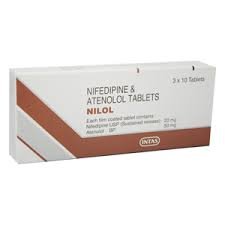
PRESCRIPTION NOTICE: Nilol Tablets are a Prescription Only Medicine (POM). They cannot legally be dispensed without a valid prescription from a licensed healthcare provider in Kenya. Do not use this medicine without medical supervision. Do not share this medicine with others even if they appear to have the same condition.
Nilol Tablets are a prescription-only fixed-dose combination antihypertensive medicine containing two pharmacologically complementary active ingredients — nifedipine 20 mg (a dihydropyridine calcium channel blocker) and atenolol 50 mg (a cardioselective beta-1 adrenergic receptor blocker). Each pack contains 30 film-coated tablets providing a one-month supply at standard once-daily dosing.
The combination of a calcium channel blocker and a cardioselective beta-blocker in a single tablet represents a clinically well-established and complementary antihypertensive strategy — targeting blood pressure through two distinct and synergistic mechanisms simultaneously while counteracting each other’s compensatory cardiovascular side effects. Nifedipine’s vasodilatory effect, which can trigger reflex tachycardia, is directly counteracted by atenolol’s heart rate-lowering action — producing superior and more comfortable blood pressure control than either agent used alone. If you have been prescribed Nilol Tablets for hypertension treatment in Kenya or angina management, this medicine must be taken strictly as directed by your healthcare provider. The price of Nilol Tablets in Kenya varies by pharmacy and is dispensed only on presentation of a valid prescription.
Key Benefits
- Dual-action antihypertensive — combines two complementary mechanisms in a single once-daily tablet for superior blood pressure control
- Nifedipine directly relaxes and dilates peripheral arteries — reducing vascular resistance and blood pressure
- Atenolol slows heart rate and reduces cardiac output — complementing nifedipine’s vasodilatory effect
- Atenolol counteracts nifedipine-induced reflex tachycardia — a key tolerability advantage of this combination over nifedipine monotherapy
- Effective antianginal combination — both agents independently reduce myocardial oxygen demand through complementary mechanisms
- Fixed-dose combination format — reduces pill burden and simplifies dosing, supporting long-term treatment adherence
- Cardioselective beta-1 blockade — atenolol has lower beta-2 receptor activity than non-selective beta-blockers such as propranolol, reducing the risk of bronchospasm in mildly asthmatic patients
- Once-daily dosing — supports consistent blood pressure control and long-term adherence
- Well-established and widely used combination in Kenyan clinical practice
- Avoid grapefruit and grapefruit juice — grapefruit inhibits nifedipine metabolism and can significantly increase its plasma levels and side effects
What It Is & How It Works
Active Ingredients
Each film-coated tablet contains:
| Active Ingredient | Strength | Role |
|---|---|---|
| Nifedipine | 20 mg | Dihydropyridine calcium channel blocker — relaxes arterial smooth muscle, reducing peripheral vascular resistance and blood pressure |
| Atenolol | 50 mg | Cardioselective beta-1 adrenergic receptor blocker — reduces heart rate, cardiac output, and blood pressure |
How Each Ingredient Works
Nifedipine 20 mg — Dihydropyridine Calcium Channel Blocker
Nifedipine selectively blocks voltage-gated L-type calcium channels in vascular smooth muscle cells. By preventing calcium influx into arterial smooth muscle cells, nifedipine:
- Causes direct relaxation and dilation of peripheral arterioles — significantly reducing systemic vascular resistance and arterial blood pressure
- Dilates coronary arteries — improving myocardial blood supply and relieving angina
- Reduces the afterload on the heart — decreasing the workload the left ventricle must overcome with each contraction
- Can trigger reflex tachycardia — a compensatory increase in heart rate driven by baroreceptor activation in response to vasodilation and blood pressure lowering; this reflex tachycardia is directly and effectively counteracted by atenolol in this combination
Atenolol 50 mg — Cardioselective Beta-1 Adrenergic Receptor Blocker
Atenolol selectively blocks beta-1 adrenergic receptors located predominantly in the heart, with relatively lower affinity for beta-2 receptors in the bronchi and peripheral vasculature — a cardioselectivity that distinguishes it from non-selective beta-blockers such as propranolol:
- Negative chronotropy — reduces resting and exercise heart rate by slowing sinoatrial (SA) node depolarisation; directly counteracts the reflex tachycardia triggered by nifedipine’s vasodilatory effect
- Negative inotropy — reduces the force of myocardial contraction, lowering cardiac output and blood pressure
- Negative dromotropy — slows AV node conduction, reducing ventricular rate in supraventricular arrhythmias
- Suppression of renin release — inhibits beta-1 receptor-mediated renin secretion from the kidney, reducing RAAS activation and contributing to sustained blood pressure lowering
- Reduction in myocardial oxygen demand — by reducing heart rate and contractility, atenolol significantly reduces myocardial oxygen consumption, complementing nifedipine’s coronary vasodilatory anti-anginal effect
The Synergistic Combination Effect
The combination of nifedipine and atenolol produces superior antihypertensive and antianginal efficacy compared to either agent alone through mutual complementarity:
- Nifedipine’s vasodilation lowers blood pressure and improves coronary blood flow but triggers compensatory reflex tachycardia — atenolol directly blocks this reflex
- Atenolol’s cardiac output reduction lowers blood pressure but can cause slight peripheral vasoconstriction — nifedipine’s direct arterial dilation offsets this
- Both agents independently reduce myocardial oxygen demand through different mechanisms — atenolol via rate and contractility reduction, nifedipine via afterload reduction and coronary dilation — producing additive antianginal benefit
Classification
Nilol Tablets are classified as a Prescription Only Medicine (POM) in Kenya. They must only be initiated, monitored, and adjusted by a licensed healthcare provider. A valid prescription is required for dispensing at any registered pharmacy in Kenya.
Formulation
Film-coated tablets. Each pack contains 30 tablets. Tablets should be swallowed whole with water, with or without food, at the same time each day. Do not crush or chew.
Uses & Indications
Nilol Tablets are indicated for the management of:
- Essential hypertension (primary high blood pressure) — in adult patients requiring combination antihypertensive therapy, or as a step-up from individual agents
- Stable angina pectoris — to reduce the frequency and severity of angina episodes and improve exercise tolerance
- Hypertension with concurrent stable angina — where both conditions require simultaneous management, the dual-action combination of Nilol is particularly clinically appropriate
- As part of a broader cardiovascular risk reduction programme — alongside appropriate lifestyle modification, dietary management, and other cardiovascular medicines as directed by a physician
IMPORTANT: The decision to initiate, adjust, or discontinue Nilol therapy must be made exclusively by a licensed healthcare provider. Do not self-prescribe or alter your dose without medical advice. Do not stop taking this medicine suddenly without consulting your doctor — abrupt discontinuation of the atenolol component can precipitate rebound tachycardia, hypertension, unstable angina, or acute myocardial infarction in patients with coronary artery disease.
Dosage & Administration
This medicine requires a valid prescription. Use only as prescribed by your healthcare provider. The following dosage information is provided for general reference only and does not constitute prescribing advice.
| Patient Group | Dose | Frequency |
|---|---|---|
| Adults with hypertension or angina | As directed | As directed |
| Elderly patients (65+ years) | As directed | As directed |
| Renal impairment (mild to moderate) | Use with caution — atenolol is renally excreted; dose reduction may be required; consult physician | As directed by physician |
| Severe renal impairment | As directed | As directed |
| Hepatic impairment | As directed | As directed by physician |
| Paediatric patients (under 18 years) | Not recommended without specialist advice | As directed |
Administration Instructions
- Take this medicine exactly as prescribed — do not increase, decrease, or skip doses without medical advice
- Take once daily at the same time each day — consistent timing ensures stable drug levels and blood pressure control
- May be taken with or without food
- Swallow tablets whole with a full glass of water — do not crush or chew
- Avoid grapefruit and grapefruit juice throughout treatment — grapefruit inhibits CYP3A4-mediated metabolism of nifedipine, significantly increasing its plasma levels and the risk of hypotension, flushing, and other side effects
- Do not stop taking this medicine suddenly without consulting your doctor — always taper the atenolol component gradually over 1–2 weeks under medical supervision to prevent rebound cardiovascular effects
- If a dose is missed, take it as soon as you remember on the same day — if the next day has begun, skip the missed dose and continue as normal; do not double dose
- Attend all scheduled follow-up appointments for blood pressure and heart rate monitoring
Possible Side Effects
Like all medicines, Nilol Tablets may cause side effects in some patients. Report any new or worsening symptoms to your healthcare provider promptly.
Common
- Peripheral oedema (ankle and foot swelling) — a well-recognised class effect of nifedipine related to its vasodilatory mechanism; usually mild; report if worsening or severe
- Flushing or facial warmth — related to nifedipine’s vasodilation; usually mild and transient, most common at the start of treatment
- Headache — usually mild and transient; often improves with continued use
- Dizziness or light-headedness — particularly upon standing; rise slowly from sitting or lying positions
- Fatigue or tiredness — related to atenolol’s reduction in cardiac output; usually mild
- Cold extremities — hands and feet may feel cold due to atenolol’s reduction in peripheral circulation
- Bradycardia (slow heart rate) — report to your doctor if heart rate falls below 50–60 beats per minute
Less Common
- Nausea or gastrointestinal discomfort
- Constipation — a recognised side effect of nifedipine
- Sleep disturbances or vivid dreams — atenolol has lower CNS penetration than propranolol but mild sleep disturbances may occur
- Erectile dysfunction in male patients
- Mild bronchospasm — despite atenolol’s cardioselectivity, some degree of bronchospasm may occur in sensitive individuals; monitor respiratory symptoms carefully
- Hypotension (low blood pressure) — particularly after first dose, in volume-depleted patients, or elderly individuals; may cause dizziness or fainting
WARNING: Rare but serious — seek immediate medical attention if you experience: severe bradycardia or AV heart block (very slow or irregular pulse), acute heart failure decompensation (sudden breathlessness, ankle swelling, or rapid weight gain), severe hypotension causing loss of consciousness, severe bronchospasm or difficulty breathing, severe allergic reactions (rash, swelling of the face or throat, difficulty breathing), severe skin reactions, or signs of significant ischaemia in the extremities. In patients with coronary artery disease, abrupt discontinuation of atenolol carries a risk of precipitating acute coronary syndrome — never stop this medicine suddenly without medical guidance.
This is not a complete list of side effects. Report all side effects to your healthcare provider.
Warnings & Precautions
CONTRAINDICATION: Do NOT use Nilol Tablets if you have bronchial asthma or severe COPD, acute decompensated heart failure, cardiogenic shock, second- or third-degree AV block without a pacemaker, sick sinus syndrome, severe bradycardia (below 60 bpm at rest before treatment), severe hypotension, Prinzmetal’s (vasospastic) angina, known hypersensitivity to nifedipine, atenolol, other dihydropyridines, other beta-blockers, or any excipient in this formulation.
Do Not Use If You:
- Have bronchial asthma or severe COPD — atenolol, despite its cardioselectivity, carries a risk of significant bronchospasm; absolute caution is required
- Have acute decompensated heart failure or cardiogenic shock
- Have significant bradycardia or advanced heart block without a pacemaker
- Have Prinzmetal’s (vasospastic) angina — beta-blockade may worsen coronary vasospasm
- Have known hypersensitivity to nifedipine, atenolol, or any dihydropyridine or beta-blocker
- Are pregnant — nifedipine and atenolol have both been associated with fetal harm; consult a specialist urgently regarding alternative antihypertensive therapy in pregnancy
- Are breastfeeding — both atenolol and nifedipine pass into breast milk; consult a doctor before use
Use With Caution If You Have:
- Mild to moderate asthma or COPD — use only under specialist supervision with careful respiratory monitoring; a dihydropyridine plus ARB combination may be a safer alternative
- Diabetes mellitus — atenolol may mask hypoglycaemia symptoms (tachycardia and tremor); sweating may remain as a warning sign; monitor blood glucose carefully
- Significant renal impairment — atenolol is primarily renally excreted; dose reduction and close monitoring are required
- Hepatic impairment — nifedipine is extensively hepatically metabolised; impaired liver function increases nifedipine plasma levels; use with caution and monitor closely
- Peripheral artery disease or Raynaud’s phenomenon — atenolol may worsen peripheral circulation symptoms
- Heart failure — both agents require careful specialist supervision in heart failure
- Elderly patients — increased susceptibility to hypotension, bradycardia, and falls
- Phaeochromocytoma — do not use without prior alpha-blockade; beta-blockade alone may cause paradoxical hypertensive crisis
Do Not Combine With (Selected Key Interactions — Consult Pharmacist for Full Review):
- Calcium channel blockers of the verapamil or diltiazem type — risk of severe bradycardia, AV block, and cardiac failure; potentially life-threatening
- Other antihypertensive agents or diuretics — additive hypotensive effects; monitor blood pressure closely
- CYP3A4 inhibitors (ketoconazole, itraconazole, ritonavir, clarithromycin, erythromycin, grapefruit juice) — significantly increase nifedipine plasma levels; risk of severe hypotension and enhanced vasodilatory side effects; avoid grapefruit throughout treatment
- CYP3A4 inducers (rifampicin, carbamazepine, phenytoin, St John’s Wort) — reduce nifedipine plasma levels, potentially reducing antihypertensive efficacy; dose adjustment may be required
- Digoxin — atenolol may increase digoxin levels; nifedipine may also affect digoxin concentrations; monitor digoxin levels
- Insulin and oral antidiabetic agents — atenolol masks hypoglycaemia symptoms; monitor blood glucose carefully
- NSAIDs (ibuprofen, diclofenac, aspirin) — may reduce the antihypertensive effect of atenolol and worsen renal function
- Clonidine — when stopping both medicines, always withdraw atenolol first before tapering clonidine to prevent rebound hypertension
- Antiarrhythmic agents (amiodarone, flecainide) — additive bradycardia and conduction disturbances with atenolol
- Alcohol — enhances the hypotensive effect of nifedipine; advise patients to limit alcohol consumption
- Tacrolimus and cyclosporine — nifedipine may increase their plasma levels; monitor immunosuppressant levels closely
- Simvastatin at high doses — nifedipine inhibits simvastatin metabolism via CYP3A4; consider dose reduction of simvastatin to reduce myopathy risk
CLINICAL NOTE (Kenya-specific): Nilol Tablets represent a practical, affordable, and clinically effective fixed-dose combination for the management of hypertension and angina in the Kenyan population. Several Kenya-specific considerations are important in the safe use of this product. Asthma prevalence in Kenya is significant and rising — pharmacists dispensing Nilol must screen all patients for asthma and history of bronchospasm before dispensing, given atenolol’s bronchospasm risk even at cardioselective doses. Grapefruit consumption — while less common than in some other populations — is increasing in Kenyan urban areas; patients must be specifically counselled to avoid grapefruit and grapefruit juice throughout treatment due to its significant inhibitory effect on nifedipine metabolism. Renal impairment — a growing comorbidity in Kenya driven by hypertension, diabetes, and endemic infections — significantly affects atenolol elimination; regular renal function monitoring is essential in patients on this combination. Diabetes management requires careful attention as atenolol masks hypoglycaemia symptoms, a particularly important safety consideration given the high and growing prevalence of type 2 diabetes in Kenya and the widespread use of sulphonylureas and insulin. Nifedipine-induced peripheral oedema — a common side effect — should be differentiated from heart failure-related oedema, which can be challenging in hypertensive patients with concurrent cardiac comorbidities; clinical assessment is important before attributing ankle swelling solely to the medication.
Keep out of reach of children. Store all medicines safely and securely.
Storage Instructions
- Store below 25°C in a cool, dry place
- Protect from direct sunlight, moisture, and excessive heat — nifedipine is light-sensitive and degrades on prolonged exposure to light
- Keep tablets in their original blister packaging
- Store out of reach and sight of children
- Do not use after the expiry date printed on the packaging
- Do not transfer tablets to another container
- Dispose of unused or expired tablets safely at your local registered pharmacy — do not flush down the toilet or discard in household waste
Mandatory Disclaimer
This medicine requires a valid prescription. Do not use without medical advice. Nilol Tablets (Nifedipine + Atenolol) are a Prescription Only Medicine (POM) that must be initiated, monitored, and adjusted exclusively by a licensed healthcare provider. Do not self-prescribe, purchase without a valid prescription, or share this medicine with others. Never stop taking Nilol suddenly without medical guidance — abrupt discontinuation of the atenolol component is dangerous and may precipitate serious cardiac events. Avoid grapefruit and grapefruit juice throughout treatment. Regular medical follow-up including blood pressure monitoring, heart rate assessment, and renal function testing is a non-negotiable component of safe Nilol therapy. This product information is provided for general educational reference only and does not constitute medical advice or replace the guidance of a qualified healthcare professional.
Reviews
There are no reviews yet.