
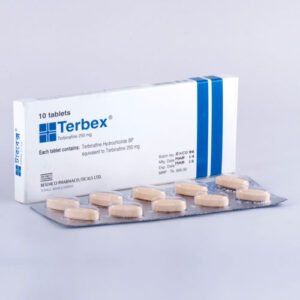
PRESCRIPTION NOTICE: Terbex 250 mg is a Prescription Only Medicine (POM). It cannot legally be dispensed without a valid prescription from a licensed healthcare provider in Kenya. Do not use this medicine without medical supervision. Do not share this medicine with others even if they appear to have the same condition.
Product Overview
Terbex Tablets 250 mg are a prescription-only oral antifungal medicine containing terbinafine hydrochloride as the active ingredient. Each pack contains 10 tablets of terbinafine 250 mg, formulated for the systemic treatment of dermatophyte fungal infections of the nails, skin, and scalp that are either too extensive, too deep, or too resistant to respond adequately to topical antifungal therapy alone.
Terbinafine is an allylamine antifungal agent that works by a mechanism distinct from azole antifungals, making it particularly effective against dermatophytes — the group of fungi most commonly responsible for nail infections (onychomycosis), ringworm (tinea corporis), athlete’s foot (tinea pedis), and scalp ringworm (tinea capitis). If you have been prescribed Terbex 250 mg for fungal nail infection treatment in Kenya or any other dermatophyte infection, this medicine must be taken strictly as directed by your healthcare provider for the full prescribed duration. The price of Terbex 250 mg in Kenya varies by pharmacy and is dispensed only on presentation of a valid prescription.
Key Benefits
- Highly effective against dermatophyte fungi — the most common cause of nail, skin, and scalp fungal infections in Kenya
- Fungicidal action — kills fungal cells outright rather than simply inhibiting their growth, leading to more durable treatment outcomes
- Achieves high concentrations in the skin, hair, and nail tissue — the target sites of dermatophyte infection
- Oral formulation is suitable for extensive, deep, or treatment-resistant fungal infections where topical therapy is insufficient
- Proven efficacy for onychomycosis (fungal nail infection) — one of the most difficult-to-treat superficial fungal infections
- Shorter treatment courses compared to older oral antifungals such as griseofulvin
- Well-established safety profile with extensive global clinical use
- Included in international dermatological treatment guidelines as a first-line oral antifungal for dermatophytosis
What It Is & How It Works
Active Ingredient
Each tablet contains:
| Active Ingredient | Strength | Role |
|---|---|---|
| Terbinafine Hydrochloride | 250 mg | Allylamine antifungal — inhibits fungal ergosterol synthesis causing fungal cell death |
How It Works
Terbinafine exerts its antifungal effect by selectively inhibiting squalene epoxidase, a key enzyme in the fungal ergosterol biosynthesis pathway. This inhibition leads to two simultaneous consequences that are lethal to fungal cells:
- Ergosterol depletion — ergosterol is an essential structural component of the fungal cell membrane. Without adequate ergosterol, the fungal cell membrane loses integrity, fluidity, and function, ultimately causing cell death
- Squalene accumulation — the blockade of squalene epoxidase causes squalene to accumulate to toxic levels within the fungal cell, further contributing to cell death
This dual mechanism produces a fungicidal (fungus-killing) effect against dermatophytes, as opposed to the fungistatic (fungus-inhibiting) effect produced by azole antifungals. The fungicidal action of terbinafine is a key reason for its superior efficacy and lower relapse rates in dermatophyte infections.
Following oral administration, terbinafine is highly lipophilic (fat-soluble) and rapidly accumulates in the stratum corneum of the skin, sebum, hair follicles, and nail tissue — precisely the anatomical compartments where dermatophyte infections reside — achieving and maintaining therapeutic concentrations at these target sites throughout the treatment course.
Classification
Terbex 250 mg is classified as a Prescription Only Medicine (POM) in Kenya. It must only be initiated, monitored, and adjusted by a licensed healthcare provider. A valid prescription is required for dispensing at any registered pharmacy in Kenya.
Formulation
Uncoated or film-coated tablets. Each pack contains 10 tablets. Tablets should be swallowed whole with water and may be taken with or without food.
Uses & Indications
Terbex 250 mg Tablets are indicated for the oral treatment of:
- Onychomycosis (fungal nail infections) — caused by dermatophytes affecting the toenails or fingernails, including subungual and total dystrophic onychomycosis
- Tinea corporis (ringworm of the body) — extensive or treatment-resistant cases not responding to topical therapy
- Tinea pedis (athlete’s foot) — severe or widespread infection, particularly the moccasin (hyperkeratotic) type
- Tinea cruris (jock itch / groin ringworm) — extensive or recurrent dermatophyte infection of the groin and inner thighs
- Tinea capitis (scalp ringworm) — particularly in children, where oral therapy is the standard of care
- Tinea manuum (ringworm of the hands) — extensive dermatophyte infection of the palms and interdigital spaces
IMPORTANT: Terbex 250 mg is specifically effective against dermatophyte fungi. It has limited efficacy against Candida species and is not indicated as first-line treatment for candidal infections such as oral thrush, vaginal candidiasis, or candidal nail infections (candidal onychomycosis). A correct fungal diagnosis — ideally confirmed by microscopy or culture — should be established before initiating oral terbinafine therapy.
Dosage & Administration
This medicine requires a valid prescription. Use only as prescribed by your healthcare provider. The following dosage information is provided for general reference only and does not constitute prescribing advice.
| Indication | Adult Dose | Duration |
|---|---|---|
| Onychomycosis — Toenails | As directed | As directed |
| Onychomycosis — Fingernails | As directed | As directed |
| Tinea Corporis / Cruris | As directed | As directed |
| Tinea Pedis (Moccasin type) | As directed | As directed |
| Tinea Capitis (Children) | Weight-based dosing — as directed by physician | As directed |
| Hepatic or Renal Impairment | Not recommended or dose reduction required | As directed by physician |
Paediatric Dosing (Tinea Capitis)
| Child’s Weight | Dose |
|---|---|
| Less than 20 kg | As directed |
| 20–40 kg | As directed |
| Greater than 40 kg | As directed |
Administration Instructions
- Take this medicine exactly as prescribed — do not increase, decrease, or skip doses without medical advice
- May be taken with or without food — food does not significantly affect absorption
- Swallow tablets whole with a full glass of water
- Take at the same time each day to maintain consistent drug levels in the body
- Complete the full prescribed course of treatment even if symptoms appear to have resolved — premature discontinuation is a leading cause of treatment failure and relapse, particularly in nail infections
- If a dose is missed, take it as soon as you remember — if it is almost time for the next dose, skip the missed dose and continue as normal; do not double dose
- Attend all scheduled follow-up appointments — liver function tests may be required during prolonged courses
Possible Side Effects
Like all medicines, Terbex 250 mg may cause side effects in some patients. Report any new or worsening symptoms to your healthcare provider promptly.
Common
- Gastrointestinal disturbances — nausea, diarrhoea, abdominal discomfort, dyspepsia, and bloating; usually mild and improve with continued use or administration with food
- Headache
- Skin rash or mild itching
- Altered or loss of taste sensation (dysgeusia or ageusia) — a well-recognised side effect of terbinafine; usually reversible upon discontinuation but may persist for weeks after stopping treatment
Less Common
- Loss of appetite
- Dizziness
- Joint or muscle pain (arthralgia or myalgia)
- Visual disturbances
WARNING: Rare but serious — seek immediate medical attention and discontinue Terbex if you experience: signs of liver damage (persistent nausea, severe fatigue, yellowing of the skin or eyes, dark urine, pale stools, right upper abdominal pain), severe skin reactions including Stevens-Johnson Syndrome or Toxic Epidermal Necrolysis (widespread blistering, peeling, or painful skin), signs of serious blood disorders (unusual bruising or bleeding, persistent sore throat, fever, unusual fatigue), or severe taste disturbance that significantly impacts nutrition and quality of life. Although rare, terbinafine-induced hepatotoxicity can be serious and has been reported to cause liver failure in exceptional cases.
This is not a complete list of side effects. Report all side effects to your healthcare provider.
Warnings & Precautions
CONTRAINDICATION: Do NOT use Terbex if you have known hypersensitivity to terbinafine or any excipient in the formulation, or if you have chronic or active liver disease.
Do Not Use If You:
- Have pre-existing chronic or active liver disease — terbinafine is extensively metabolised by the liver and carries a risk of hepatotoxicity
- Have severe kidney disease (creatinine clearance below 50 mL/min) — use is generally not recommended; consult your doctor
- Are known to be hypersensitive to terbinafine or any allylamine antifungal
Use With Caution If You Have:
- A history of liver disease or elevated liver enzymes — baseline liver function tests are recommended before initiating a prolonged course
- Psoriasis — rare cases of terbinafine-induced psoriasis exacerbation have been reported
- Lupus erythematosus — terbinafine may trigger or worsen lupus; discontinue if lupus-like symptoms develop
- Depression or mood disorders — rare cases of serious psychiatric reactions including depression have been reported
- Immune suppression — may alter the presentation and severity of fungal infections
Do Not Combine With:
- Rifampicin — significantly increases the metabolism of terbinafine, reducing its plasma levels and efficacy; dose adjustment may be required
- Cimetidine — inhibits terbinafine metabolism, increasing plasma levels and risk of side effects
- Cyclosporine — terbinafine may reduce cyclosporine blood levels; monitor cyclosporine levels closely
- Warfarin and other anticoagulants — terbinafine may alter anticoagulant effect; monitor INR closely
- Tricyclic antidepressants, SSRIs, beta-blockers, and antiarrhythmics metabolised by CYP2D6 — terbinafine inhibits CYP2D6 and may increase plasma levels of these medicines; consult a pharmacist for a full interaction review
- Caffeine — terbinafine reduces caffeine clearance; excessive caffeine intake may result in exaggerated caffeine effects
CLINICAL NOTE (Kenya-specific): Fungal skin and nail infections are extremely prevalent in Kenya, driven by warm and humid climatic conditions, communal bathing facilities, widespread barefoot activity, and high rates of occupational exposure to soil and water. Tinea capitis (scalp ringworm) is particularly common among school-age children in Kenya and requires oral antifungal therapy as the standard of care — topical treatment alone is ineffective for scalp infections. Clinicians should confirm the dermatophyte diagnosis before prescribing oral terbinafine, as Candida and non-dermatophyte mould infections will not respond to terbinafine and require alternative antifungal agents. Baseline liver function testing is advisable before initiating a 12-week course for onychomycosis, particularly in patients with any history of liver disease or alcohol use — both of which carry elevated prevalence in certain Kenyan populations.
Keep out of reach of children. Store all medicines safely and securely.
Storage Instructions
- Store below 25°C in a cool, dry place
- Protect from direct sunlight, moisture, and excessive heat
- Keep tablets in their original packaging
- Store out of reach and sight of children
- Do not use after the expiry date printed on the packaging
- Do not transfer tablets to another container
- Dispose of unused or expired tablets safely at your local registered pharmacy — do not flush down the toilet or discard in household waste
Mandatory Disclaimer
This medicine requires a valid prescription. Do not use without medical advice. Terbex 250 mg (Terbinafine Hydrochloride) is a Prescription Only Medicine (POM) that must be initiated, monitored, and adjusted exclusively by a licensed healthcare provider. Do not self-prescribe, purchase without a prescription, or share this medicine with others. Completing the full prescribed course is essential for treatment success — particularly for nail infections, where visible improvement may lag significantly behind microbiological cure. Regular follow-up with your prescribing clinician is strongly advised. This product information is provided for general educational reference only and does not constitute medical advice or replace the guidance of a qualified healthcare professional.
Reviews
There are no reviews yet.