
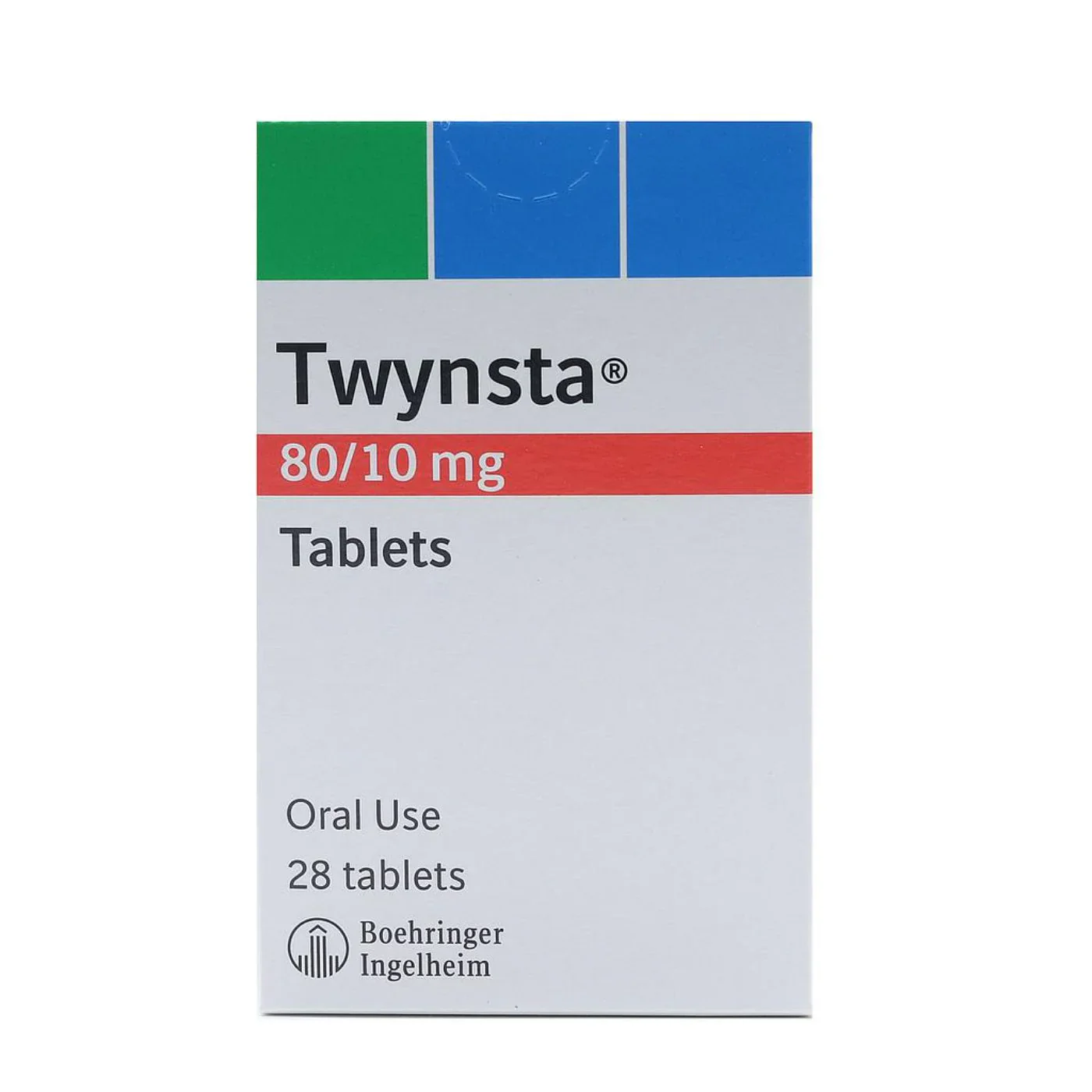
PRESCRIPTION NOTICE: Twynsta 80/10 mg is a Prescription Only Medicine (POM). It cannot legally be dispensed without a valid prescription from a licensed healthcare provider in Kenya. Do not use this medicine without medical supervision. Do not share this medicine with others even if they appear to have the same condition.
Twynsta 80/10 mg Tablets are a prescription-only fixed-dose combination antihypertensive medicine manufactured by Boehringer Ingelheim, containing two pharmacologically complementary and clinically proven active ingredients — telmisartan 80 mg (a long-acting angiotensin II receptor blocker) and amlodipine 10 mg (a dihydropyridine calcium channel blocker). Each pack contains 28 film-coated tablets providing a four-week supply at standard once-daily dosing.
Twynsta 80/10 mg represents the highest-strength formulation of the Twynsta range, combining the maximum standard doses of both telmisartan and amlodipine in a single tablet. This combination targets hypertension through two entirely distinct and complementary mechanisms — telmisartan blocking the renin-angiotensin-aldosterone system (RAAS) and amlodipine directly relaxing arterial smooth muscle through calcium channel blockade — producing superior and more sustained blood pressure reduction than either agent achieves independently. If you have been prescribed Twynsta 80/10 mg for hypertension treatment in Kenya, this medicine must be taken strictly as directed by your healthcare provider. The price of Twynsta 80/10 mg in Kenya varies by pharmacy and is dispensed only on presentation of a valid prescription.
Key Benefits
- Dual-action antihypertensive — combines two distinct, complementary mechanisms in a single once-daily tablet for superior blood pressure control
- Telmisartan — the longest-acting ARB available, providing genuine 24-hour blood pressure coverage including control of the critical early morning blood pressure surge
- Amlodipine — smooth, sustained 24-hour vasodilation with minimal reflex tachycardia due to its exceptionally long half-life of 35–50 hours
- Both components at maximum standard doses — 80 mg telmisartan and 10 mg amlodipine — providing the most potent blood pressure lowering within the Twynsta range
- Telmisartan’s unique PPARγ partial agonist activity — delivers additional insulin-sensitising and metabolic benefits beyond blood pressure lowering, particularly relevant in hypertensive patients with metabolic syndrome or diabetes
- Fixed-dose combination format — reduces pill burden from two separate tablets to a single once-daily tablet, significantly improving long-term treatment adherence
- No ACE inhibitor-associated dry cough — telmisartan does not inhibit bradykinin degradation, providing excellent tolerability in patients intolerant of ACE inhibitors
- Cardiovascular and renal organ protection — telmisartan’s RAAS blockade and amlodipine’s vasodilation provide complementary end-organ protective benefits
- Well-established efficacy supported by the landmark ONTARGET, TRANSCEND, and TEAMSTA clinical trial programmes
- Once-daily dosing — supports consistent 24-hour blood pressure control and long-term adherence
What It Is & How It Works
Active Ingredients
Each film-coated tablet contains:
| Active Ingredient | Strength | Role |
|---|---|---|
| Telmisartan | 80 mg | Long-acting selective AT1 receptor antagonist (ARB) with additional PPARγ partial agonist activity |
| Amlodipine Besylate | Equivalent to Amlodipine 10 mg | Dihydropyridine calcium channel blocker — relaxes arterial smooth muscle and reduces peripheral vascular resistance |
How Each Ingredient Works
Telmisartan 80 mg — Long-Acting ARB with PPARγ Activity
Telmisartan is a highly selective, non-competitive antagonist of the angiotensin II type 1 (AT1) receptor — the receptor through which angiotensin II exerts its vasoconstrictive, aldosterone-stimulating, and pro-fibrotic effects. By binding with exceptionally high affinity to AT1 receptors and dissociating from them very slowly, telmisartan:
- Blocks angiotensin II-mediated vasoconstriction of arterial and arteriolar smooth muscle — reducing peripheral vascular resistance and systemic blood pressure
- Inhibits angiotensin II-stimulated aldosterone secretion — reducing sodium and water retention and intravascular blood volume
- Prevents angiotensin II-driven cardiac hypertrophy and vascular remodelling — providing long-term protection against hypertensive end-organ damage
- Reduces intraglomerular pressure in the kidneys — providing nephroprotective benefits particularly valuable in hypertensive patients with diabetes or proteinuria
- Stimulates angiotensin II type 2 (AT2) receptors via elevated circulating angiotensin II — producing vasodilatory and antiproliferative effects that complement AT1 blockade
Why Telmisartan Has the Longest Duration of Action Among All ARBs Telmisartan’s half-life of approximately 20–24 hours — the longest of any ARB — results from its exceptionally high lipophilicity, large volume of distribution, and non-competitive binding at the AT1 receptor. Unlike competitive ARBs, telmisartan cannot be displaced from the AT1 receptor by rising endogenous angiotensin II levels, ensuring sustained receptor blockade throughout the full dosing interval. This translates into superior control of the early morning blood pressure surge — the period between 6 AM and noon when cardiovascular events including stroke and myocardial infarction are most common.
Telmisartan’s Unique PPARγ Partial Agonist Activity Uniquely among ARBs, telmisartan acts as a partial agonist at peroxisome proliferator-activated receptor gamma (PPARγ) — a nuclear receptor regulating genes governing glucose and lipid metabolism. This activity produces improved insulin sensitivity, favourable lipid metabolic effects, and reduced adipose tissue inflammation — benefits of particular clinical relevance in hypertensive patients with metabolic syndrome, pre-diabetes, or type 2 diabetes, all of which are rapidly increasing in prevalence in Kenya.
Amlodipine 10 mg — Long-Acting Dihydropyridine Calcium Channel Blocker
Amlodipine selectively blocks voltage-gated L-type calcium channels in vascular smooth muscle cells. By preventing calcium influx into arterial smooth muscle cells, amlodipine:
- Causes direct relaxation and sustained dilation of peripheral arterioles — significantly reducing systemic vascular resistance and arterial blood pressure
- Dilates coronary arteries — improving myocardial oxygen supply; clinically beneficial in patients with concurrent stable angina
- Produces a smooth, sustained antihypertensive effect over 24 hours due to its exceptionally long half-life of approximately 35–50 hours — the longest of any dihydropyridine calcium channel blocker
- Minimises blood pressure fluctuations between doses — providing stable 24-hour coverage without the peaks and troughs associated with shorter-acting calcium channel blockers
- Has minimal negative inotropic effect at therapeutic doses — does not significantly reduce cardiac contractility or output
The Dual-Action Synergy of Telmisartan and Amlodipine
Telmisartan and amlodipine lower blood pressure through entirely distinct and non-overlapping mechanisms, producing synergistic rather than merely additive antihypertensive effects:
- Amlodipine’s direct arterial vasodilation can trigger compensatory RAAS activation — renin and angiotensin II levels may rise in response to vasodilation-induced blood pressure lowering, partially attenuating amlodipine’s effect over time
- Telmisartan’s AT1 receptor blockade directly counteracts this compensatory RAAS activation — blocking the vasoconstrictive and sodium-retaining effects of the elevated angiotensin II and sustaining the antihypertensive benefit of amlodipine
- Telmisartan’s volume-reducing effect via aldosterone inhibition complements amlodipine’s vasodilatory mechanism, addressing both the vascular resistance and volume components of hypertension simultaneously
- Amlodipine’s peripheral oedema side effect — caused by its vasodilatory effect increasing capillary hydrostatic pressure — is partially reduced by telmisartan’s mild diuretic effect via aldosterone inhibition, improving the tolerability of the combination compared to amlodipine monotherapy
Classification
Twynsta 80/10 mg is classified as a Prescription Only Medicine (POM) in Kenya. It must only be initiated, monitored, and adjusted by a licensed healthcare provider. A valid prescription is required for dispensing at any registered pharmacy in Kenya.
Formulation
Film-coated tablets. Each pack contains 28 tablets. Tablets should be swallowed whole with water, with or without food, at the same time each day. Note that telmisartan tablets are moisture-sensitive — keep in original packaging until immediately before use.
Uses & Indications
Twynsta 80/10 mg Tablets are indicated for:
- Essential hypertension (primary high blood pressure) — in adult patients whose blood pressure is not adequately controlled on amlodipine 10 mg monotherapy alone, or as a step-up from lower-strength Twynsta formulations (40/5 mg, 40/10 mg, 80/5 mg)
- Fixed-dose combination step-up therapy — as a simplification strategy in patients already stabilised on telmisartan 80 mg and amlodipine 10 mg taken as separate tablets, reducing pill burden to a single once-daily tablet
- Hypertension with concurrent cardiovascular risk factors — including patients with metabolic syndrome, type 2 diabetes, coronary artery disease, or stable angina, under appropriate clinical guidance
- Hypertension in patients intolerant of ACE inhibitors — telmisartan provides equivalent RAAS blockade to ACE inhibitors without the risk of ACE inhibitor-induced cough, which has a significantly higher incidence in Black African patients
IMPORTANT: Twynsta 80/10 mg contains the maximum standard doses of both telmisartan and amlodipine. It is not intended as initial first-line therapy in newly diagnosed, uncomplicated hypertension — treatment is typically started with lower doses of individual agents or lower-strength combination tablets and titrated upward based on blood pressure response. The decision to initiate, adjust, or discontinue Twynsta therapy must be made exclusively by a licensed healthcare provider.
Dosage & Administration
This medicine requires a valid prescription. Use only as prescribed by your healthcare provider. The following dosage information is provided for general reference only and does not constitute prescribing advice.
| Patient Group | Dose | Frequency |
|---|---|---|
| Adults with inadequately controlled hypertension on amlodipine 10 mg | As directed by physician | As directed by physician |
| Elderly patients (65+ years) | As directed by physician | As directed by physician |
| Mild to moderate renal impairment | As directed by physician | As directed by physician |
| Severe renal impairment | As directed by physician | As directed by physician |
| Mild to moderate hepatic impairment | As directed by physician | As directed by physician |
| Severe hepatic impairment | As directed by physician | Not recommended |
| Paediatric patients (under 18 years) | Not recommended — safety and efficacy not established | Not applicable |
Administration Instructions
- Take this medicine exactly as prescribed — do not increase, decrease, or skip doses without medical advice
- Take once daily at the same time each day — consistent timing maximises 24-hour blood pressure coverage
- May be taken with or without food — food does not significantly affect the absorption of either telmisartan or amlodipine
- Swallow tablets whole with a full glass of water — do not crush, chew, or split
- Remove tablets from the blister immediately before use — telmisartan is moisture-sensitive and will degrade if left out of the blister packaging
- Do not stop taking this medicine suddenly without consulting your doctor — abrupt discontinuation may result in rebound blood pressure elevation
- If a dose is missed, take it as soon as you remember on the same day — if the next day has begun, skip the missed dose and continue as normal; do not double dose
- Maintain adequate hydration — particularly in hot weather, during physical activity, or during illness involving vomiting or diarrhoea — to prevent excessive blood pressure lowering
- Attend all scheduled follow-up appointments for blood pressure monitoring, renal function, and serum electrolyte checks — particularly potassium monitoring
Possible Side Effects
Like all medicines, Twynsta 80/10 mg may cause side effects in some patients. Report any new or worsening symptoms to your healthcare provider promptly.
Common
- Peripheral oedema (ankle and foot swelling) — a well-recognised class effect of amlodipine related to its vasodilatory mechanism; usually mild and partially offset by telmisartan’s mild diuretic effect compared to amlodipine monotherapy; report if worsening or severe
- Dizziness or light-headedness — particularly upon standing; rise slowly from sitting or lying positions; orthostatic hypotension is most common after dose increases
- Headache — usually mild and transient; often improves with continued treatment
- Flushing or facial warmth — related to amlodipine’s vasodilatory effect; usually mild and transient
- Fatigue or weakness
Less Common
- Hypotension (low blood pressure) — particularly in volume-depleted patients; may cause dizziness, fainting, or falls
- Palpitations or tachycardia — mild reflex tachycardia from amlodipine’s vasodilation; usually transient
- Hyperkalaemia (elevated serum potassium) — ARB class effect; particularly relevant in patients with renal impairment, diabetes, or those taking potassium-sparing diuretics or supplements; regular potassium monitoring is essential
- Elevated creatinine — a modest rise in serum creatinine on initiation of ARB therapy is expected; significant or progressive rises warrant medical review
- Nausea or abdominal discomfort
- Back pain or musculoskeletal pain
- Upper respiratory tract infections — sinusitis, nasopharyngitis
WARNING: Rare but serious — seek immediate medical attention if you experience: angioedema (sudden swelling of the face, lips, tongue, or throat — a potentially life-threatening emergency; although less common with ARBs than ACE inhibitors, telmisartan-induced angioedema has been reported), severe hypotension causing loss of consciousness (particularly after first dose, volume depletion, or concurrent illness), acute kidney injury (significant reduction in urine output or rapidly rising creatinine — particularly in patients with bilateral renal artery stenosis), severe hyperkalaemia (muscle weakness, paralysis, or cardiac arrhythmias), or severe hepatic reactions (jaundice, severe abdominal pain, dark urine).
This is not a complete list of side effects. Report all side effects to your healthcare provider.
Warnings & Precautions
CONTRAINDICATION: Do NOT use Twynsta 80/10 mg if you are pregnant, have severe hepatic impairment, biliary obstructive disorders, known hypersensitivity to telmisartan, amlodipine, other dihydropyridines, or any excipient in this formulation, or cardiogenic shock, haemodynamically unstable heart failure after acute myocardial infarction.
Do Not Use If You:
- Are pregnant — telmisartan causes serious and potentially fatal fetal harm including renal dysplasia, oligohydramnios, limb contractures, neonatal renal failure, and fetal death; ARBs are absolutely contraindicated throughout all trimesters of pregnancy
- Are breastfeeding — telmisartan passes into breast milk; use is not recommended during breastfeeding
- Have severe hepatic impairment or biliary obstructive disorders — telmisartan is almost exclusively eliminated via biliary excretion; severe hepatic impairment causes dramatically elevated plasma levels
- Have cardiogenic shock or haemodynamically unstable heart failure after acute myocardial infarction — amlodipine is contraindicated in this setting
- Have known hypersensitivity to telmisartan, amlodipine, or any dihydropyridine calcium channel blocker
Use With Caution If You Have:
- Renal artery stenosis (bilateral or to a single functioning kidney) — ARBs can precipitate acute kidney injury; use under specialist supervision with close monitoring
- Volume or sodium depletion — correct before initiating therapy to reduce first-dose hypotension risk
- Mild to moderate hepatic impairment — use lower-strength Twynsta formulation (maximum telmisartan 40 mg); monitor liver function
- Severe renal impairment — limited clinical data; monitor renal function and electrolytes closely
- Severe aortic stenosis or hypertrophic obstructive cardiomyopathy — risk of severe hypotension from amlodipine’s vasodilation
- Heart failure — amlodipine may be used in heart failure with caution; telmisartan use in heart failure requires specialist supervision
- Primary hyperaldosteronism — ARBs are generally less effective in this condition
- Diabetes mellitus — monitor potassium levels closely; telmisartan’s PPARγ activity may alter insulin sensitivity; amlodipine is generally well tolerated in diabetes
- Elderly patients — increased susceptibility to hypotension, falls, and renal impairment
Do Not Combine With (Selected Key Interactions — Consult Pharmacist for Full Review):
- Other RAAS blockers (ACE inhibitors, aliskiren) — dual RAAS blockade significantly increases the risk of hypotension, hyperkalaemia, and acute renal failure without additional cardiovascular benefit; avoid combination
- Potassium-sparing diuretics (spironolactone, amiloride, eplerenone) or potassium supplements — additive hyperkalaemia risk with telmisartan; monitor serum potassium closely
- Lithium — telmisartan may reduce renal lithium excretion, increasing lithium toxicity risk; monitor lithium levels closely or avoid combination
- NSAIDs (ibuprofen, diclofenac, aspirin) — reduce the antihypertensive effect of telmisartan, increase acute kidney injury risk, and may worsen ARB-related electrolyte disturbances; the ARB-NSAID combination is potentially dangerous and should be avoided where possible
- CYP3A4 inhibitors (ketoconazole, itraconazole, ritonavir, clarithromycin, grapefruit juice) — may significantly increase amlodipine plasma levels, enhancing its vasodilatory and hypotensive effects; monitor blood pressure closely and for amlodipine side effects including oedema
- CYP3A4 inducers (rifampicin, carbamazepine, phenytoin, St John’s Wort) — may reduce amlodipine plasma levels, potentially reducing antihypertensive efficacy; monitor blood pressure
- Digoxin — telmisartan may increase digoxin peak and trough plasma concentrations; monitor digoxin levels at initiation of Twynsta and with dose changes
- Antidiabetic agents — telmisartan’s PPARγ activity may enhance insulin sensitivity; monitor blood glucose and adjust antidiabetic therapy if necessary to avoid hypoglycaemia
- Other antihypertensive agents, diuretics, or vasodilators — additive hypotensive effects; monitor blood pressure closely
- Simvastatin at doses above 20 mg — amlodipine inhibits simvastatin metabolism; consider dose reduction of simvastatin or switching to a non-CYP3A4-metabolised statin to reduce myopathy risk
- Tacrolimus and cyclosporine — amlodipine may increase their plasma levels; monitor immunosuppressant levels closely
- Alcohol — enhances the hypotensive effect of both components; advise patients to limit alcohol consumption
CLINICAL NOTE (Kenya-specific): Twynsta 80/10 mg offers a clinically compelling combination for the significant proportion of Kenyan hypertensive patients who require dual antihypertensive therapy. Several Kenya-specific considerations are important in the use of this product. The high prevalence of ACE inhibitor-induced persistent dry cough in Black African patients — estimated to affect up to 15–20% of Black patients on ACE inhibitors — makes telmisartan a particularly well-tolerated and adherence-friendly RAAS blocker in the Kenyan population, as it carries no cough risk. Telmisartan’s superior 24-hour blood pressure coverage is especially important in Kenya, where a significant proportion of hypertensive patients are engaged in early morning physical labour in agricultural, construction, and domestic occupations — placing them at heightened cardiovascular risk during the early morning blood pressure surge. Telmisartan’s PPARγ-mediated metabolic benefits are highly relevant in Kenya’s rapidly evolving epidemiological context, where hypertension increasingly co-exists with type 2 diabetes and metabolic syndrome. Amlodipine-induced peripheral oedema — although partially attenuated by telmisartan in this combination — remains a recognised side effect that Kenyan patients commonly misattribute to cardiac or renal disease; patient education on this expected side effect is important to prevent unnecessary alarm and treatment discontinuation. The absolute contraindication in pregnancy must be emphasised to all women of childbearing potential, given the serious and potentially fatal fetal consequences of ARB exposure during pregnancy.
Keep out of reach of children. Store all medicines safely and securely.
Storage Instructions
- Store below 30°C in a cool, dry place
- Protect from direct sunlight, moisture, and excessive heat
- Keep tablets in their original blister packaging at all times — telmisartan is moisture-sensitive and degrades rapidly if exposed to humidity
- Remove tablets from the blister immediately before use only
- Do not handle tablets with wet hands
- Store out of reach and sight of children
- Do not use after the expiry date printed on the packaging
- Do not transfer tablets to another container
- Dispose of unused or expired tablets safely at your local registered pharmacy — do not flush down the toilet or discard in household waste
Mandatory Disclaimer
This medicine requires a valid prescription. Do not use without medical advice. Twynsta 80/10 mg (Telmisartan + Amlodipine) is a Prescription Only Medicine (POM) that must be initiated, monitored, and adjusted exclusively by a licensed healthcare provider. Do not self-prescribe, purchase without a valid prescription, share this medicine with others, or stop treatment without consulting your doctor. Twynsta is absolutely contraindicated in pregnancy — women of childbearing potential must use effective contraception during treatment and must inform their doctor immediately if they become or plan to become pregnant. Regular medical follow-up including blood pressure monitoring, renal function tests, and serum electrolyte checks is a non-negotiable component of safe and effective Twynsta therapy. This product information is provided for general educational reference only and does not constitute medical advice or replace the guidance of a qualified healthcare professional.
References
- Boehringer Ingelheim — Twynsta Tablets: Summary of Product Characteristics and Official Prescribing Information
- European Society of Hypertension (ESH) & European Society of Cardiology (ESC) — Guidelines for the Management of Arterial Hypertension: Fixed-Dose Combination Therapy Evidence Review and ARB plus CCB Combination Recommendations

Reviews
There are no reviews yet.